Industry Insights
UFO & Linear High Bay Lights: The Maintenance-ROI Guide for Harsh Industrial Environments
Heat, dust, grid surges and 15-meter ceilings: failure mechanics, surge and thermal engineering, radar sensing ROI math and a 12-point RFQ checklist for industrial UFO and linear high bay projects.
---
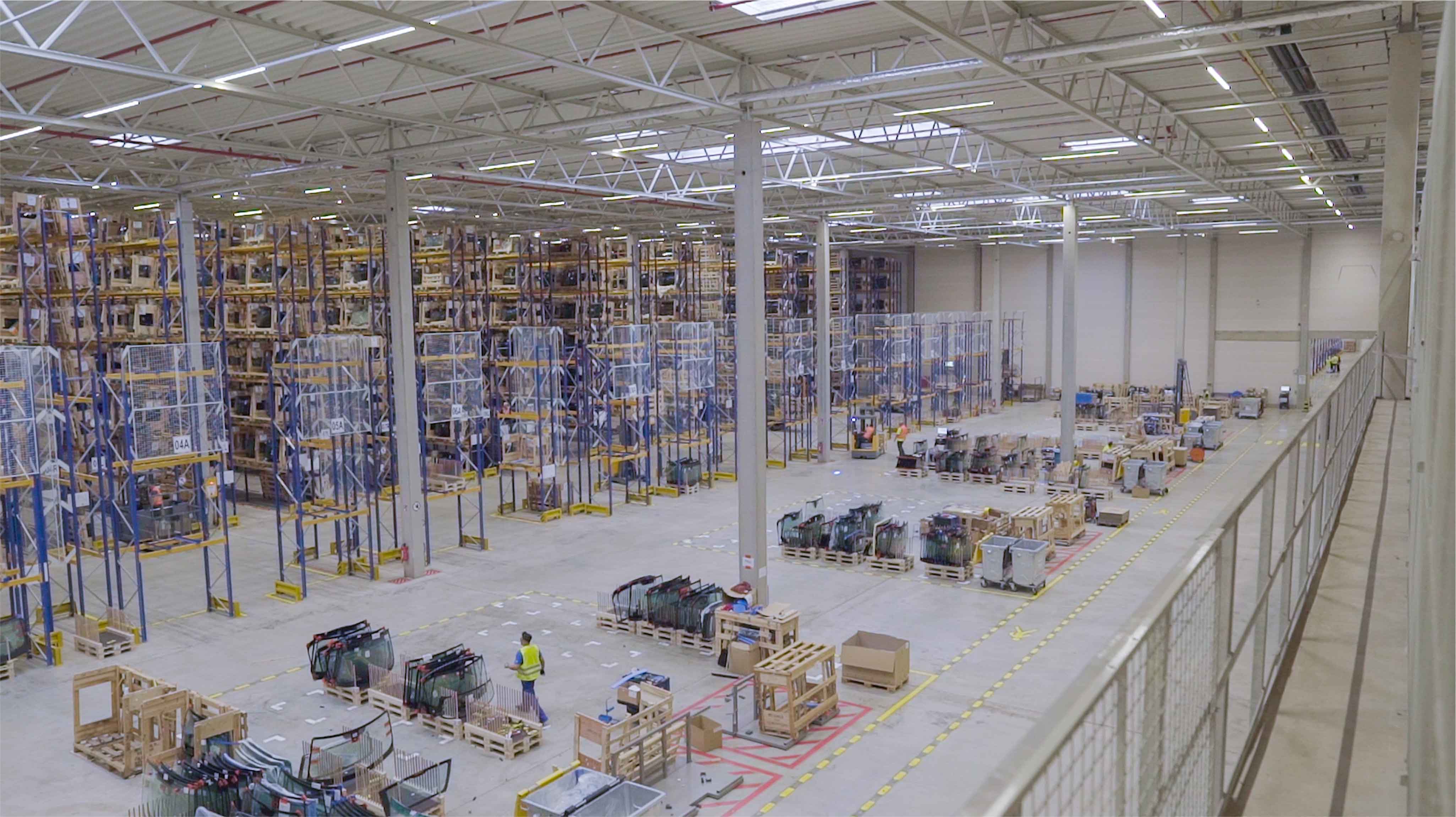
A failed high bay light at 12 meters is never just a lamp replacement. In an operating plant it means deploying scissor lifts, scheduling certified technicians around production shifts, and — when the fixture sits above a live line — stopping the line itself. Between lift rental, certified labor and downtime, a single ten-minute driver swap routinely lands between €500 and €1,500, several times the cost of the luminaire. Across a 10,000 m² facility running dozens of fixtures, that math turns lighting into an operating-cost line item.
This guide is written for the people who carry that math: international project managers, electrical contractors, wholesale distributors and factory owners evaluating UFO high bay lights and linear high bay lights for ceilings of 8-15 meters and beyond. The decisive question is not luminous efficacy on a datasheet — it is how the fixture survives four structural risks: unstable industrial grids, trapped heat at ceiling level, extreme dust, and the maintenance economics of extreme mounting heights. Section by section, this guide breaks down each failure mechanism, the engineering that counters it, and the ROI case for integrated smart controls.
1. Four Failure Mechanisms — and the Hardware That Counters Them
Grid fluctuation: why factory power kills commodity drivers
Industrial grids sag and surge constantly: welders, CNC equipment and large motor starts drag voltage down and kick transients back up the line, and seasonal lightning induces surges across long distribution runs. A commodity driver without dedicated protection either trips offline (an entire zone going dark mid-shift) or absorbs the hit until it fails.
The counter-measure is a Surge Protection Device (SPD) engineered as an independent stage: differential-mode protection at 6 kV with common-mode endurance up to 10-20 kV, tested against the IEC 61000-4-5 class system and specified per IEEE C62.41 environment categories. Wide-input designs (200-240 V AC for European grids; 277-480 V for North American distribution) reject narrow-voltage commodity parts altogether. One parameter never printed on quotes deserves a sample test: after a deep voltage sag, does the driver recover automatically and hold stable output — or latch off until someone cycles the mains?
Heat stratification: the elevated micro-climate
Heat rises and stagnates. High-bay fixtures live in an elevated micro-climate that runs far hotter than the shop floor — 55-65 °C is routine near foundries, die-casting cells and unventilated roof decks — and electrolytic capacitors inside the driver age on a half-life curve for roughly every 10 °C of additional heat. The LEDs outlive the driver, and the driver is the part hanging at 12 meters.
Engineering counters, in order of impact: external driver placement in accessible service boxes (the failed component is never the one at height); driver derating with Tc ratings above the real ambient plus 20-30% headroom; cross-ventilation thermal design — open-frame housings with uninterrupted air paths that sweep ambient flow across the heatsink fins instead of trapping it; and high-temperature burn-in evidence (fixtures validated at elevated ambient, not just room-temperature photometrics).
Dust: the heat sink wearing a blanket
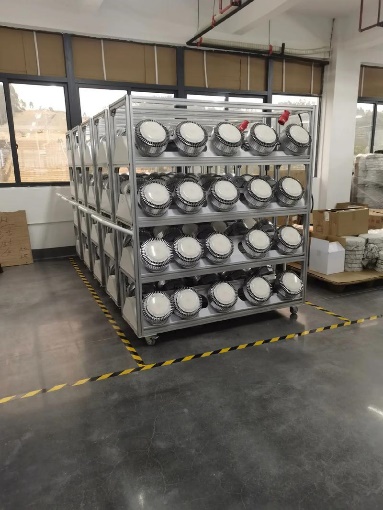
In textile, wood, cement and grain processing plants, fin gaps clog within two years. A blanketed heat sink loses 30-50% of its dissipation, junction temperatures climb, lumen depreciation accelerates, and dust works into driver compartments and terminals. The fix is structural: one-piece die-cast UFO housings with no seams to leak (comfortably IP66/IP67, IK10-rated against the knocks of crane and forklift environments per IEC 62262), wide-pitch vertically oriented fins that stay clean far longer than dense horizontal combs, and — in food processing — IP69K washdown variants for high-pressure, hygienic environments. Lighting calculations for dusty plants should carry a 15-20% maintenance factor rather than laboratory assumptions.
Height: optical precision meets mechanical endurance
At 12-15 meters, the wrong beam angle produces exactly two outcomes — patched light with dark lanes between (a forklift safety problem, not a comfort problem) or brute-force wattage (an energy bill problem). High-bay optics come in 60°/90°/120° and asymmetric distributions matched to mounting height and layout, with anti-glare optical lenses and shrouds holding UGR at or below 19-22 so forklift operators keep full visibility of moving loads. Uniformity and illuminance targets follow EN 12464-1 for the relevant task area, verified in DIALux with the maintenance factors above.
Mechanically, crane rails and punch presses shake fixtures for a decade: junction boxes, hooks and housings are qualified against EN 60068-2-6 vibration testing, with dual suspension (hook plus safety cable) and IK10 impact housings as the standard for high-risk zones.
2. Smart Control Architectures: From Static Load to Managed Asset
The ROI case for high bay controls stacks in three layers.
Layer 1 — LED conversion economics. Replacing a 400 W metal halide with a 150 W UFO high bay typically cuts fixture energy 60-70%, and eliminates the 12-18 month metal-halide relamping cycle — each relamp being another lift-and-labor event. Payback for the conversion alone commonly lands within one to two years in two-shift facilities, calibrated to local tariffs.
Layer 2 — sensing and daylight harvesting. The operational fact of warehousing: most aisles are empty most of the time. Integrated radar motion sensors — microwave modules using Doppler reflection — hold reliable detection at mounting heights up to 15 meters, penetrating dust, smoke and air currents where PIR thermal footprints fade into background noise at height. Fixtures run 100% in the active aisle and dim to a 10-30% standby level elsewhere, preserving code-level minimum illuminance. Layered on top, 0-10V dimming with daylight harvesting scales output down proportionally to the daylight entering skylights and dock doors, holding a constant baseline lux automatically. Combined, sensing plus daylight strategies in low-traffic warehouses typically cut consumption 50-80% against always-on operation — a ratio locked down per project with a zoning simulation before tender.
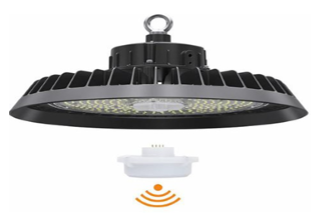
Layer 3 — cluster management. Zigbee mesh or DALI systems turn hundreds of fixtures into a monitored network: failed fixtures report their own position (no more visual inspection sweeps at 12 meters), zoning strategies adjust in software, and energy reports come out by zone. Emergency variants integrate self-testing backup packs per EN 60598-2-22 for evacuation compliance. The engineering red lines carry over from the hardware section: microwave placement rules in closed cabinets, hundred-thousand-cycle sensor verification, and drivers paired and curve-tested so low-level dimming holds SVM≤0.4 — the EU ecodesign limit that applies to high bay luminaires exactly as it does to every other category.
3. UFO vs Linear High Bay: A Structural Decision, Not a Style Choice
Dimension | UFO High Bay | Linear High Bay |
|---|---|---|
Thermal structure | Circular one-piece finned heat sink, 360° convection; superior thermal-area-per-watt | Extruded profile sheds heat along its length; suited to continuous mid-power runs |
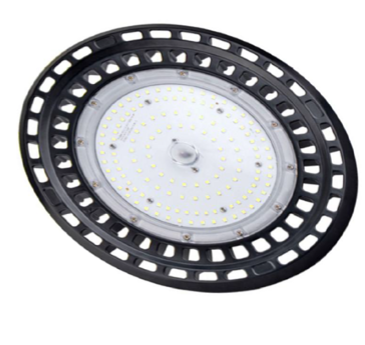
Optics | Point-source logic: 60°/90°/120° beams and reflectors for aimed delivery | Line-source logic: even distribution along the run; naturally fits long aisles |
Protection ceiling | IP66/IP67, IK10 readily achievable (die-cast, seam-free) | IP65 typical; end caps and seams are the points to inspect |
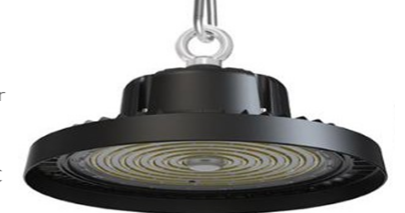
Best field | Open high spaces, heavy dust, heavy industry, 12-20 m | Racking aisles (light over the lane), assembly halls, sorting lines |
Power range | 100-500 W per unit, external driver options | 40-150 W per bar, continuous layouts |
Smart options | Integrated radar sensing, Zigbee clustering, emergency variants — all available | Same integration set; bar format suits aisle-level "people in, light on" |
The selection rule: open areas, harsh environments and extreme heights go UFO; narrow aisles, continuous lines and lane-lighting go linear. Large plants usually take both — UFO over open floors, linear along racking lanes — managed by one control ecosystem.
4. Standard Commodity vs Industrial-Grade Specification: The TCO Matrix
For procurement teams and electrical wholesalers, the engineering deltas below decide ten-year total cost of ownership. Purchase price is typically 10-15% of TCO; energy runs 60-70%; maintenance 15-25% — which makes every row in this matrix a cost line, not a feature line.
Parameter | Standard Commodity High Bay | ARTLITE Industrial Premium Spec | Project Outcome |
|---|---|---|---|
System luminous efficacy | 110-130 lm/W | 150-180 lm/W (premium tier) | 20-35% lower energy spend at identical lux targets |
Surge protection topology | 4 kV driver-integrated only | 6 kV differential / up to 20 kV independent SPD stage | Isolates the driver from grid transients; in our project experience the single biggest lever on premature driver failure |
Smart sensing | None, or basic PIR | Integrated industrial radar sensor | Reliable detection through dust, smoke and drafts at heights to 15 m |
Dimming protocols | Static non-dimmable output | 0-10V / PWM / DALI-2 | Integrates with BMS and energy management suites; smooth low-level dimming |
Unified glare rating | UGR>25 (exposed array) | UGR≤19 / ≤22 (optics + shroud) | Protects forklift operators' sight lines; aligns with occupational safety practice |
Ambient thermal range | -20°C to +40°C | -30°C to +55°C, 6063-T5 aluminum body | Holds performance in foundries, heavy manufacturing and unconditioned logistics bays |
Vibration endurance | Not specified | EN 60068-2-6 tested, dual suspension | Survives crane and press environments without fastener fatigue |
Emergency option | Rare | 15-30 W backup packs, 1-2 h autonomy, self-test | Maintains evacuation compliance through power disruptions |
5. Market Notes for International Projects
- Europe: CE per EN 60598-1; SVM≤0.4 at full load (EU 2019/2020) applies to high bays; EN 12464-1 illuminance and uniformity; DALI-2 ecosystems mature — and with European labor rates, external drivers and long-life components are the ROI levers.
- North America: UL/ETL (UL1598 family); DLC listing — DLC Premium models let your customers claim utility rebate money, the most common hidden benefit in North American high bay projects; 277-480 V distribution; efficacy claims verified against DLC test data.
- Middle East: 55 °C+ ambient derating, SASO certification, dust strategy per the section above.
- Food processing: IP69K washdown variants and corrosion-resistant housings are the entry ticket; standard IP66 is not washdown.
- Hazardous locations: ATEX/IECEx is a separate explosion-proof product family — standard high bays must not be substituted. Flag these zones explicitly.
6. What Each Buyer Type Should Pressure-Test
EPC and general contractors (tender-driven): every specification line needs a report behind it; a missing certificate kills a bid. ARTLITE answers tender specifications line by line with test documentation (EN 60598-1, flicker and efficacy data, surge and vibration reports, IP/IK ratings), supplies DIALux files, and locks production capacity to project milestones.
Plant owners and facility directors (TCO-driven): the external-driver + surge + thermal-derating reliability package, sensing and cluster management as a dashboard, and a ten-year TCO comparison model under two-shift assumptions. A quote that saves 20% on purchase price while halving service life is the most expensive option on the table.
Lighting designers (effect and compliance): high-bay optics with shielding accessories, DIALux files with maintenance factors stated, scene-differentiated CCT (4000K production, 5000K inspection and design zones, 4000K warehouse), raised CRI at inspection stations.
Electrical contractors (installation and service): fast-fit hooks with safety cables, pre-terminated driver wiring, plug-in connectors, emergency variants with self-test, and mounting hardware shared across the power range.
7. OEM/ODM Customization for Industrial Projects
No two plants share a layout, and chasing optimal lux while protecting capital expenditure demands flexible builds. ARTLITE GROUP provides factory-level customization for industrial high bay configurations:
- Global driver integration: project-exact drivers specified per regional grid — Meanwell, Philips, Lifud, Osram, Sosen or equivalent platforms.
- Asymmetric and symmetric lenses: 60°, 90° or double-asymmetric distributions that throw light down narrow racking aisles instead of onto walls.
- Flexible emergency topologies: internal backup packs at 15-30 W delivering 1-2 hours of autonomy with self-test.
- Structure and sensing: integrated radar modules, Zigbee clustering, DALI-2, external-driver architectures, IP66-IP69K and IK10 builds per environment.
Standard platforms sample in 1-3 days, bulk runs 10-15 days, MOQ from 100 pcs, and every custom program runs under NDA by default.
8. Industrial Procurement FAQ
Q: Why do standard industrial high bay lights frequently fail within 12 to 24 months of installation? A: In our project experience the majority of premature high bay failures originate in the driver circuitry, not the LED chips. Commodity drivers degrade continuously under machine-induced grid transients and the heat trapped at ceiling level. Fixtures built with an independent SPD stage and cross-ventilation thermal design isolate the driver from both hazards — which is what makes a 50,000-hour system lifespan claim realistic rather than theoretical.
Q: How do radar sensors outperform PIR at mounting heights above 10 meters? A: PIR tracks changing thermal footprints, which blend into background noise at height and are blocked by dust and fast-moving air. A radar module works on microwave reflection, penetrating dust, smoke and air streams to hold reliable detection up to 15 meters — and dims the zone to standby the moment it empties.
Q: What does DALI-2 or 0-10V dimming deliver that simple zone switching cannot? A: Zone switching jumps between full-on and off, ignoring daylight entirely. 0-10V daylight harvesting dims fixtures smoothly against available natural light, holding uniform baseline illuminance — less eye strain, less energy, no abrupt dark-to-bright transitions across a shift.
Q: UFO or linear for a 14-meter warehouse with racking? A: Both — UFO over open staging and dock areas, linear along the racking aisles where the line-source distribution lights the lane itself. Mixing families inside one control ecosystem is standard practice in our warehouse projects.
Q: How is total cost of ownership modeled for a high bay retrofit? A: Purchase price (10-15%), energy (60-70%) and maintenance (15-25%) over a ten-year horizon, with sensing savings modeled per traffic zone. We deliver this model with two-shift assumptions on request — it is the document facility directors take to management.
Q: Which certifications should a European or North American tender require? A: Europe: CE per EN 60598-1, EN 62493 where applicable, SVM/PstLM data, EN 12464-1 compliance files. North America: UL/ETL and DLC listing for rebate eligibility. Middle East: SASO. Vibration (EN 60068-2-6) and IK ratings for industrial mechanical environments.
9. The Industrial High Bay RFQ Checklist
- Mounting height and beam angle: DIALux file delivered with the proposal?
- Driver architecture: external or integrated? Thermal derating data? Brand and capacitor grade?
- Surge protection: differential/common-mode kV? IEEE C62.41 environment statement?
- Vibration: EN 60068-2-6 report for crane and press environments?
- Protection: IP/IK ratings; lumen maintenance factor assumptions for dust?
- Smart control: sensing type and zoning strategy; Zigbee/DALI compatibility; daylight harvesting?
- Emergency: EN 60598-2-22 variants with self-test?
- Flicker: SVM/PstLM data at full load and at low dimming levels?
- Lifetime: L80B10 claim and the junction temperature assumption behind it?
- Certifications: CE/UL/ETL/DLC/SASO mapped to the target market?
- Mechanical safety: hook + safety cable dual suspension? IK rating?
- TCO: ten-year energy and maintenance comparison model available?
10. Talk to ARTLITE GROUP About Your High Bay Program
ARTLITE GROUP's high bay line covers UFO and linear formats across the full power range, with integrated radar sensing, emergency variants and Zigbee clustering as options — and every custom program starts from your plant parameters: mounting height, ambient temperature, dust class, grid quality and shift model. We reverse-engineer the driver architecture, thermal margin and control strategy from those parameters, and deliver DIALux simulations and test reports with the proposal.
Standard platforms sample in 1-3 days, bulk runs 10-15 days, MOQ from 100 pcs, custom programs under NDA by default. Send your plant parameter sheet or tender specification to sales@artlitegroup.com — engineering response within 24 hours.
ARTLITE GROUP — vertically integrated LED lighting manufacturing since 2010, serving clients in 45+ countries.