Oct 8, 2026Industry Insights
LED SKD & CKD Kits: Cut Tariff and Freight Costs Legally
Shipping LED lights as SKD or CKD kits can cut freight and duty costs. Here is how the rules work in 2026, what customs actually checks, and how to stay legal.
If you have been importing LED lighting from China for the past two years, you have lived through more tariff changes than most traders see in a decade. IEEPA "reciprocal" tariffs arrived, stacked on top of Section 301 duties, and then in February 2026 the US Supreme Court struck the IEEPA tariffs down. Section 301 stayed. European importers face their own anti-dumping walls. Buyers from Lagos to Bogotá are hunting for any legitimate way to bring landed costs back down.
One of the oldest tools in the trade, and one of the most misunderstood, is shipping lights as SKD or CKD kits: the product travels disassembled, and final assembly happens in the destination country. Done properly, it cuts freight costs and, in many high-tariff markets, cuts the duty line even more. Done carelessly, it looks like customs fraud, and customs authorities in India, the EU, and Latin America have become very good at telling the difference.
This guide covers what SKD and CKD actually mean, where the real savings come from, what the law allows as of September 2026, and how to structure a kit program that survives a customs audit.
What SKD and CKD Actually Mean
SKD (semi knocked down) means a product is partially disassembled for shipping and reassembled at its destination. CKD (completely knocked down) means it travels as a full parts set, right down to screws and cables. CBU (completely built up) is the ordinary case: finished, fully assembled units rolling off the container.
For a 36W LED panel light, an SKD kit typically contains the extruded frame in four sections, the light guide plate, the diffuser, the back plate, the LED module strip, the driver, and a labeled accessories bag. Assembly at destination takes a trained worker 15 to 20 minutes: clip the frame, lay the LGP and diffuser, connect the driver, test, done. A CKD kit for the same light goes further, down to raw extrusion lengths and separated electronic components, and suits markets with local factory capacity and local-content requirements.
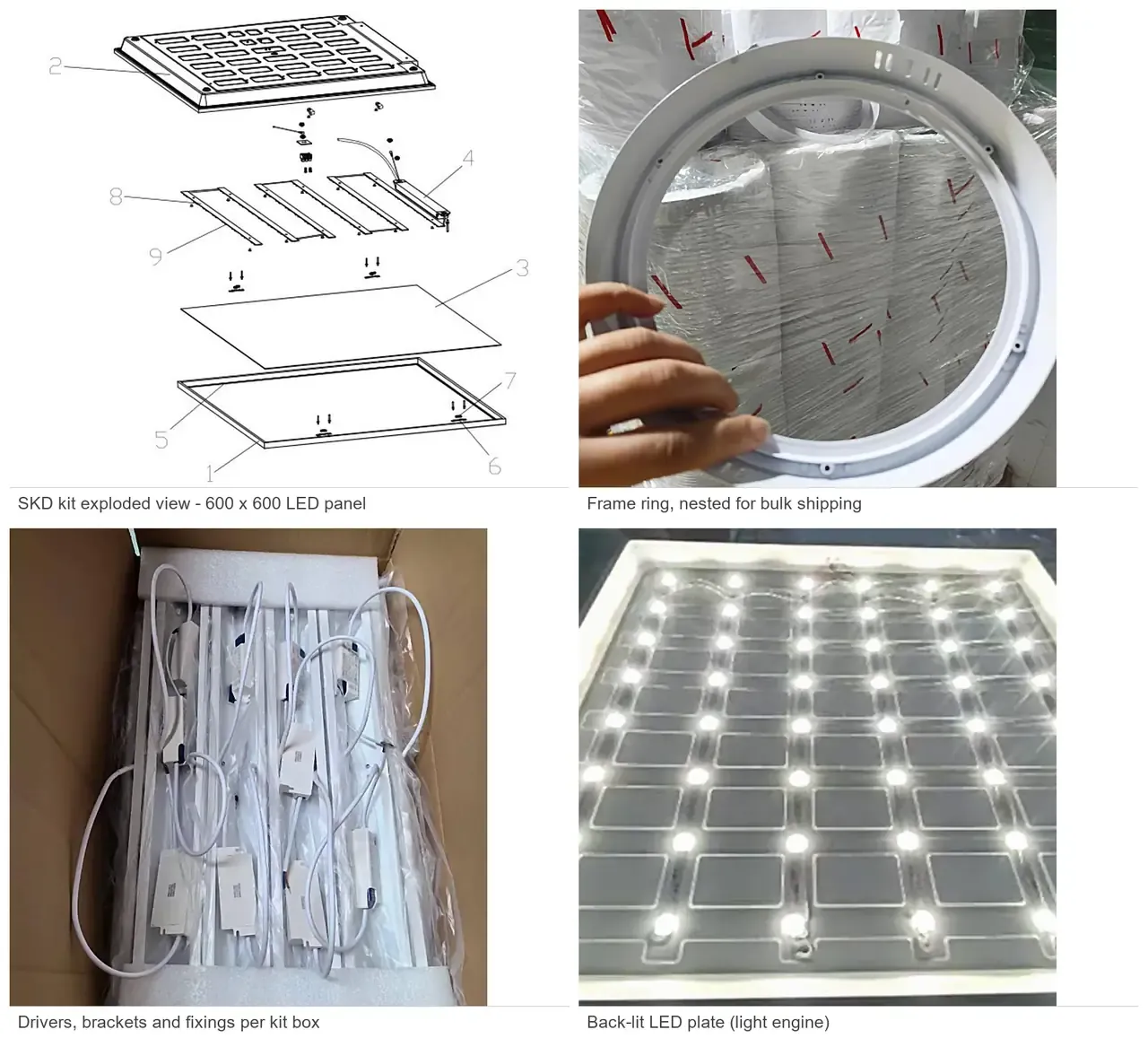
Inside an SKD kit: the exploded view of a 600×600 panel, frame sections packed in bulk, a kit box of drivers and fixings, and the back-lit LED plate.
The key idea behind both: the factory ships volume, the destination adds the labor.
What SKD Actually Saves Depends on What You Ship
Most articles promise that SKD saves duty. The honest picture has two levers, freight and duty, and which one dominates depends mainly on the shape of the product and the tariff schedule at destination.
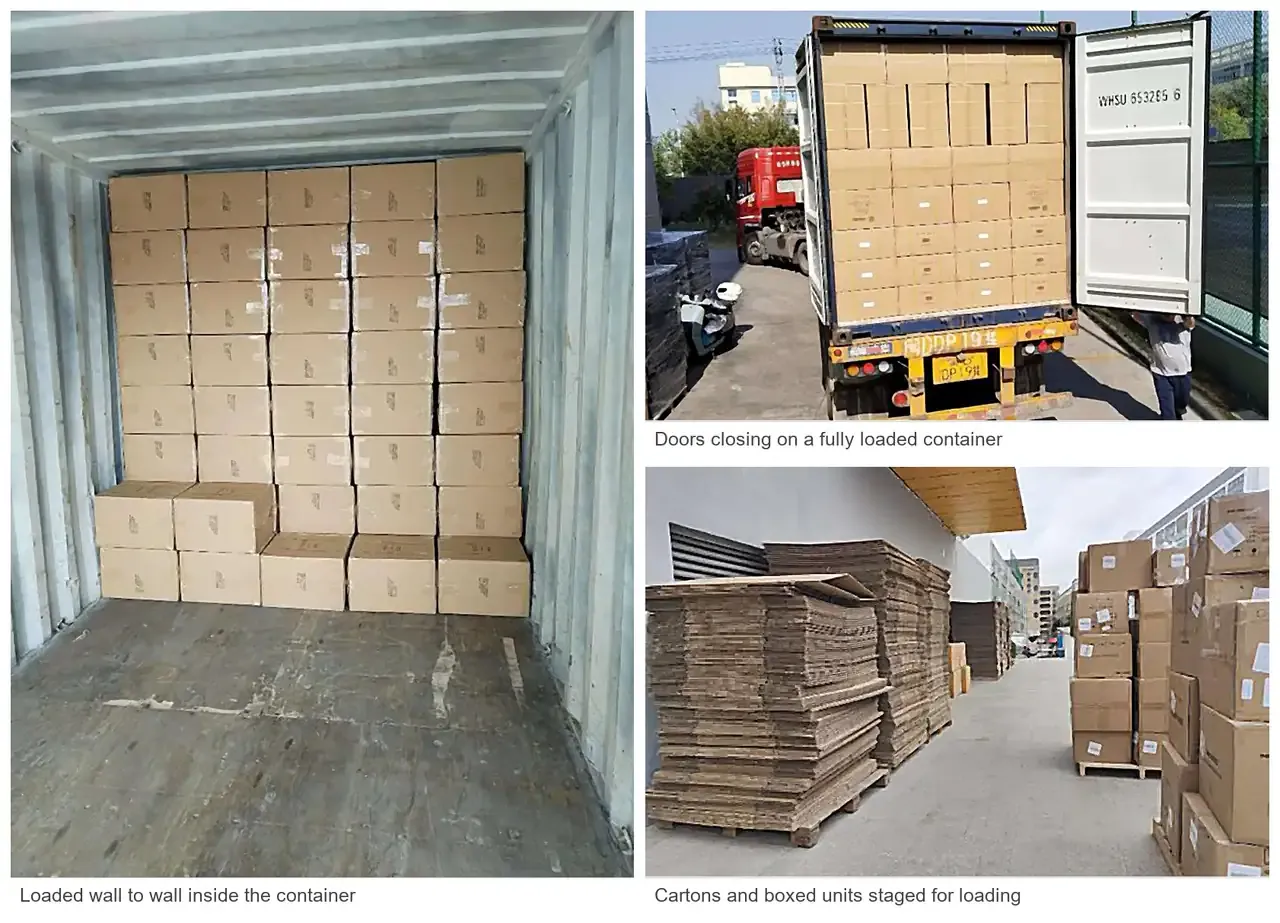
Freight: decisive for bulky fixtures, moderate for flat panels. Published supplier loading data sets the scale for the flat category. Packed ten to a master carton (64×64×22 cm), a 40ft high-cube takes about 8,000 built 600×600 panel lights. The same panel shipped as SKD kits, frames nested into bundles and drivers in their own dense cartons, raises the count to roughly 12,000 to 14,000 kits, 50 to 80 percent more product per container. Bulky fixtures play a different game: knocked-down parts for industrial housings can occupy a third to a quarter of the finished volume, three to four times the units per container. Import street lights or high bays, and freight leads the business case.
Loaded wall to wall inside the container, doors closing on a full load, and cartons staged for loading.
Duty: usually the bigger lever for flat products in high-tariff markets. Because a flat panel cannot dramatically out-pack its built version, duty differentials tend to decide the economics. Parts classifications and local-assembly rules open real gaps: finished industrial lighting into Saudi Arabia carries duties around 10 to 12 percent against about 5 percent for components; Egypt taxes finished fixtures at 20 to 30 percent while assembly-oriented parts enter at 5 to 10 percent; Turkey runs 12 to 15 percent versus 3 to 6 percent. In markets with a small parts/finished gap, including the United States, SKD is mostly a freight play, and the duty lever matters little. Anyone who tells you kits always slash duties is selling something.
A worked example shows how the two levers add up. Take a 40W 600×600 panel with an SKD kit price around $2.80 FOB, bound for a market charging 25 percent duty on finished fixtures and 7.5 percent on parts, with the 40HQ container costing $4,500. As 8,000 built units, each panel carries about $0.56 of freight and $0.70 of duty. As 13,000 kits, each carries roughly $0.35 of freight and $0.21 of duty. Total landed logistics cost falls from about $1.26 to $0.56 per unit, and close to seventy percent of that saving comes from the duty line, not the freight line. These are illustrative figures, but the ratio is typical for flat panels entering high-duty markets.
Local-content programs are the sleeper benefit. Countries that want local manufacturing increasingly regulate rather than forbid kit imports. Colombia, for example, introduced a dedicated RTE-E regime in 2026 that governs SKD/CKD imports against production and local-content conditions. Importers who comply get a legal framework; importers who ignore it get treated as evaders.
Damage rounds it out. An assembled panel light is a wide, fragile object. Flat-packed glass, LGP, and frames survive a rough port far better, and replacement-part claims drop.
The Tariff Logic, and Where the Legal Line Sits
Here is the part most guides skip, and the part that decides whether your kit program is a strategy or a liability.
Customs authorities do not object to kits. They object to fakes: finished products split into "parts" on paper, shipped with no real assembly at destination, declared under part-level codes purely to dodge finished-goods duties. That pattern has a name in enforcement circles, the "screwdriver plant," and the screwdriver has been coming down hard:
- India has long applied anti-dumping duties to lamps "whether or not assembled, whether in CKD or SKD condition," and its tribunal courts have upheld duty demands against importers who cleared finished appliances as kits to evade higher rates. Since 2020, India's customs tariff act includes explicit anti-circumvention investigation rules.
- The EU applies finished-product duty treatment to kits where circumvention is established, and its anti-circumvention guidance explicitly targets assembly operations whose local processing is negligible.
- The United States enforces anti-circumvention on its anti-dumping and countervailing duty orders, and Section 301 duties on Chinese lighting remain fully in force after the February 2026 Supreme Court ruling. Most LED fixtures still carry an additional 25% under List 3, on top of the roughly 6% MFN base rate. (The proposed 12.5% Section 301 action announced in June 2026 over forced-labor concerns was still only a proposal as of this writing.)
- Canada expanded its border agency's powers to open anti-circumvention investigations; Colombia now regulates kit imports through its own regime rather than leaving a loophole open.
The test these authorities apply is broadly the same: did genuine, valuable work happen at destination? Real assembly with real labor, real value-add, records that show it. The red flags they look for: kits imported in finished-goods volumes with no assembly trace, "parts" declarations on products that never get assembled, and invoices that do not match what is in the cartons.
So the honest summary of the legal line: SKD is legitimate when the assembly is real, the classification is correct, and the paperwork tells the truth. It is fraud when any of those three is missing.
SKD vs CKD vs CBU: A Practical Comparison
| CBU (built up) | SKD (semi knocked down) | CKD (completely knocked down) |
|---|---|---|---|
Container density | Baseline | 50–80% more kits per 40HC for panel lights; 3–4× for bulky fixtures | Highest, but bulky packaging waste |
Assembly labor at destination | None | 15–30 min/unit, semi-skilled | Significant, factory-level |
Duty exposure | Finished-goods rate | Parts rate in some markets; must be real | Local-content regimes may offer relief |
Damage risk in transit | Highest | Low | Lowest |
Compliance burden | Low | Medium: classification + records | High: local production conditions |
Best for | Standard orders, tight deadlines | High-tariff or freight-sensitive markets | Markets with local-content rules and assembly capacity |
How to Structure a Compliant SKD Program
Six steps, in the order that avoids expensive mistakes.
1. Read the destination rulebook before you design the kit. Check for anti-dumping and countervailing orders on your product category, the country's anti-circumvention history, and any formal kit regime (Colombia's RTE-E is the model to watch). If finished lamps in that market carry anti-dumping duties, assume kits do too until a broker proves otherwise.
2. Get the classification right, in writing. Finished luminaires and their parts sit under different HS headings (9405.41/49 for many finished fixtures, 9405.92 for parts). Do not guess: request a binding ruling from US Customs (CBP) or a Binding Tariff Information decision in the EU before the first container. A written ruling costs little and outlives any single shipment.
3. Design the kit around real assembly, not around the tariff schedule. The kit split should reflect how the product is genuinely assembled, and the destination work should add measurable value: labor hours, local wages, assembly premises. That record becomes your defense file if anyone ever asks.
4. Keep every document telling the same story. Commercial invoice, packing list, and bill of lading should all describe the goods as an SKD kit for assembly, with parts itemized, quantities consistent, and unit values honest. Take photos of the actual packing. Inconsistency between documents is the single most common trigger for customs scrutiny.
5. Paper the assembly side. Contract with a local assembly partner or your own facility, keep attendance and payroll records for assembly workers, and photograph the line. Value-add you cannot prove is value-add customs assumes does not exist.
6. Put a licensed customs broker in the destination market on the team. Rules shift every quarter in this trade; the broker's job is to keep you inside them. And be skeptical of any supplier who promises duty outcomes as a selling point. That promise, in writing, becomes evidence.
Country Snapshot: September 2026
United States. The Supreme Court ended the IEEPA reciprocal and fentanyl tariffs in February 2026, and CBP stopped collecting them on February 24. Section 301 is untouched: expect the ~6% MFN base plus 25% under List 3 for most Chinese LED fixtures, 7.5% for List 4A items. With the parts/finished duty gap small in the US, kits are primarily a freight calculation there. No anti-dumping or countervailing duty orders cover LED panel lights, battens, or downlights from China as of September 2026; the duty stack is MFN plus Section 301. The one recent attempt, a 2018 petition on LED lighting devices and power supplies, died in 2019 when the trade commission found no injury. That can change with a single new filing, so confirm scope with your broker before committing to a large program.
European Union. Finished luminaires, panels, battens, and downlights included, currently clear EU customs on the standard duty alone. The EU's anti-dumping attention on Chinese lighting has aimed at light sources instead: LED retrofit lamps and filaments have carried duties since 2019, and that order's life has flipped with expiry reviews, so confirm its current status with a broker if your line includes LED bulbs or tubes. The EU applies finished-goods treatment to kits where circumvention is established, and a Binding Tariff Information ruling before your first kit shipment is cheap insurance.
Middle East and Africa. Many markets here actively want local assembly, from Gulf industrial programs to African local-content rules, and SKD is a familiar, accepted trade pattern. The practical risks are commercial rather than legal: assembly quality and spare-parts completeness.
Latin America. Watch Colombia's RTE-E kit regime as the template other countries may follow: import and assemble under declared production and local-content conditions, and the legal path is open. Brazil and Mexico run their own complex regimes; local counsel pays for itself.
Frequently Asked Questions
Is SKD shipping legal?
Yes. Shipping products as semi knocked down kits for genuine assembly at destination is a normal, legal trade practice used across the lighting, automotive, and appliance industries. It becomes illegal only when kits are used to disguise finished goods, misclassify parts, or fake local processing to dodge duties.
Does importing LED lights as SKD kits really reduce duties?
It depends on the destination market and the product. Some countries tax parts lower than finished luminaires or reward local assembly through formal programs; others, including the US, apply similar rates to both, so the savings there come mainly from freight density. As a rule of thumb, bulky fixtures gain the most freight, while for flat products like 600×600 panels the duty gap often contributes more of the total saving.
What is the tariff on LED lights from China in 2026?
As of September 2026, Chinese LED fixtures entering the US carry the MFN base rate of about 6% plus a 25% Section 301 addition for most items (7.5% for List 4A goods). The IEEPA tariffs that briefly stacked on top were struck down by the Supreme Court in February 2026 and are no longer collected.
What documents does an SKD shipment need?
The same core set as any shipment, commercial invoice, packing list, and bill of lading, plus an itemized kit parts list, consistent descriptions stating the goods are SKD kits for assembly, and ideally packing photos and the destination assembly agreement. Everything must tell one consistent story.
What is the difference between SKD and CKD?
SKD (semi knocked down) ships the product partially disassembled, for example a panel light in frame sections with the light engine and driver separate. CKD (completely knocked down) ships it as a full component set down to fasteners. CKD suits markets with real factory capacity and local-content rules; SKD fits markets where assembly is simple and labor is available.
Ship Kits That Pass Inspection
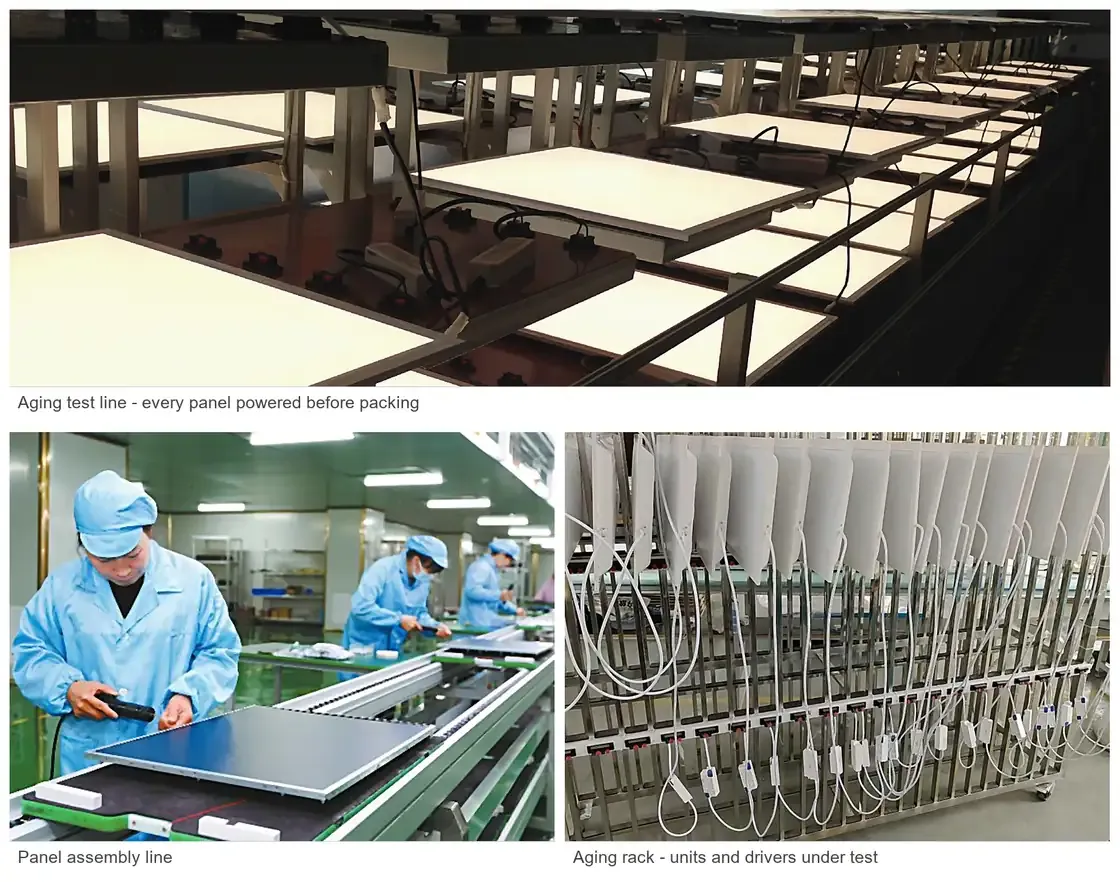
Assembly line and aging test racks: every unit is powered and aged before it is packed for shipment.
We pack panel lights, batten lights, and downlights as SKD kits for importers across the Middle East, Africa, and Latin America, with itemized packing lists, per-kit assembly instructions, and container loading calculations worked out before you commit to an order. If you want to see what a kit program would look like for your market, send us your product list and destination port and we will send back a packing plan with real numbers.
This article reflects tariff and trade-policy information as of September 2026. Rates and enforcement practices change frequently; confirm your specific situation with a licensed customs broker or trade counsel before acting. This article is general information, not legal advice.
---