Oct 8, 2026Industry Insights
How Many Watts or Lumens Do You Need for LED Flood Lights? A Room-by-Room Guide for Your Home
Not sure how many watts or lumens you need for your garage, garden or backyard court? Our wattage and lumens comparison chart covers garage, driveway, garden and home sports court with expert tips on
Choosing an LED flood light is confusing because wattage (W) tells you how much electricity it uses, not how bright it is. What you actually need to know is lumens (lm) - the measure of visible light output. A 30W flood light from one brand can outshine a 50W model from another simply because it converts electricity more efficiently. Quality LED flood lights today deliver 80 to 120 lumens per watt, which means a 30W fitting produces roughly 2,400 to 3,600 lumens - enough to fully illuminate a single garage driveway.
This guide breaks down the three most common residential flood light scenarios - garage and driveway, backyard and garden, and home sports courts - with specific wattage, lumens and colour temperature recommendations for each. A quick-reference chart at the end lets you match your space to the right fitting in seconds.
Garage and Driveway: Clear Vision for Safe Parking
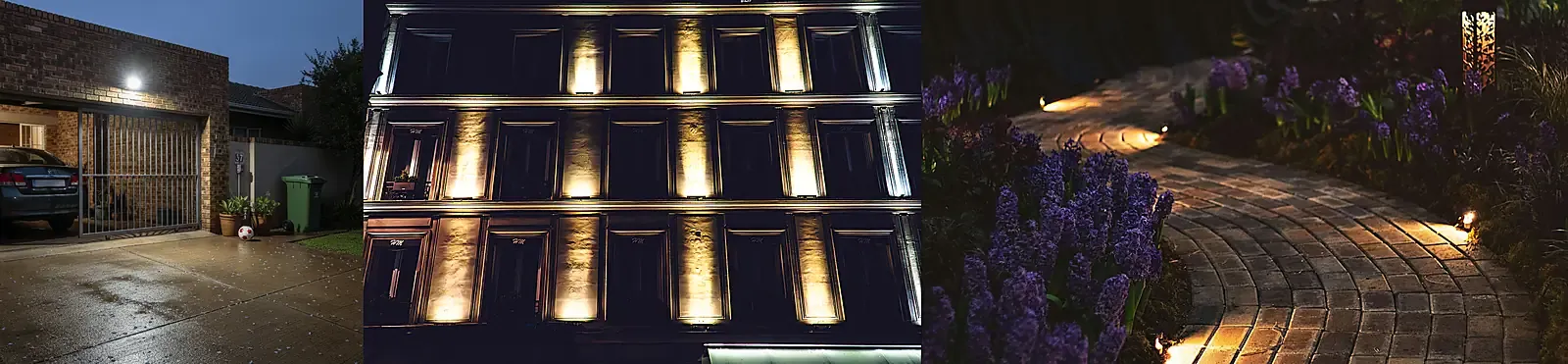
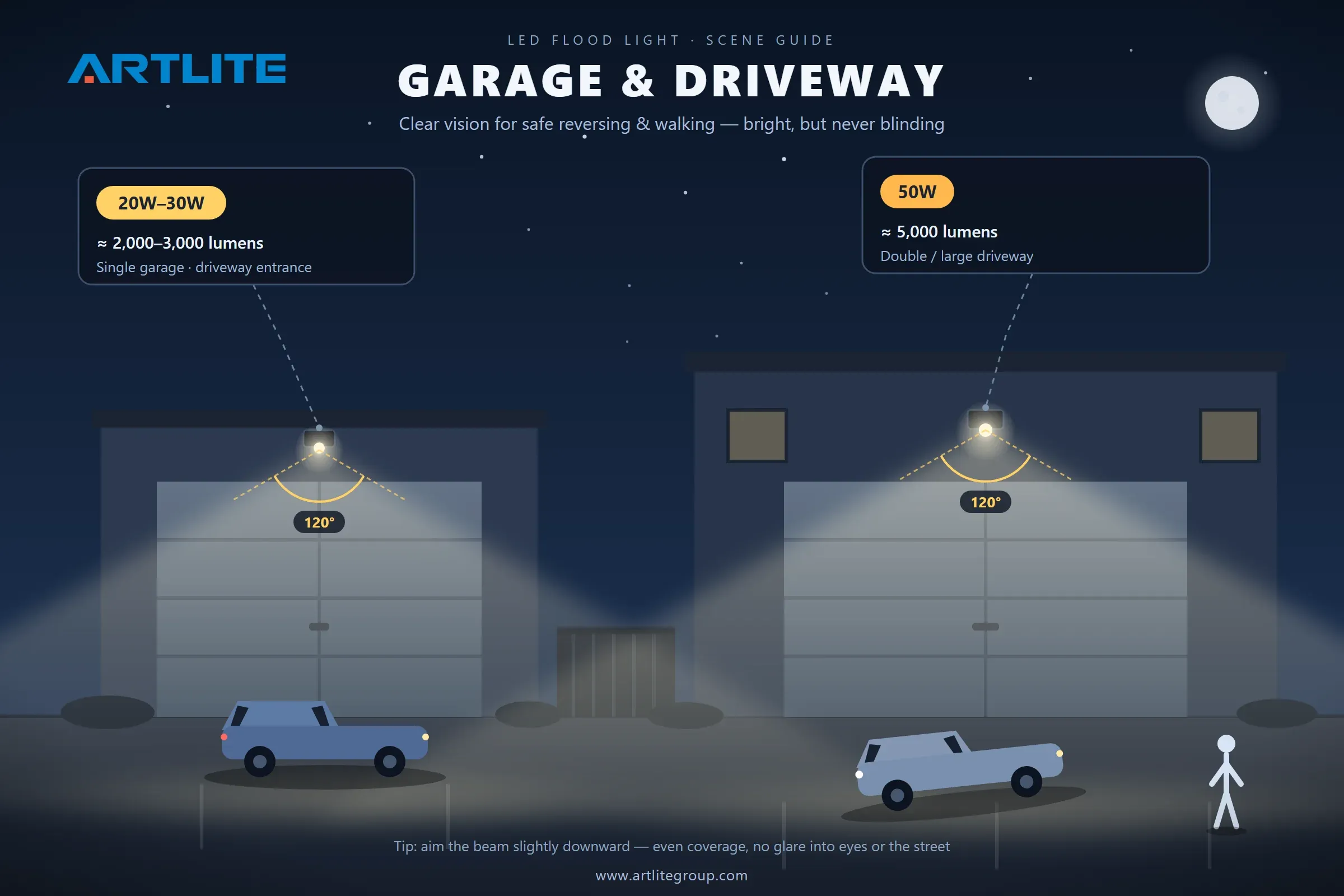
Your garage and driveway need enough light to reverse a car, spot obstacles and walk safely - but not so much that you feel like you are on a stadium pitch. For a single-car garage or driveway entrance, a 20W to 30W LED flood light producing 2,000 to 3,000 lumens is sufficient. Mount it 2.5 to 3 metres above the ground, angled slightly downward to cover the parking area without shining into neighbours' windows.
For a double-width driveway or a larger parking area, step up to a 50W unit producing around 5,000 lumens. At this level you get clear visibility for reversing, pedestrian recognition and package delivery - even on the darkest winter evenings.
Expert Tip: Add a Motion Sensor
Strongly consider a flood light with a built-in PIR (Passive Infrared) motion sensor. The light switches on automatically when a car approaches or a person walks into the detection zone. This saves electricity compared to leaving the light on all night and doubles as a theft deterrent - a sudden blast of light is enough to send most intruders running.
Backyard and Garden: Security Meets Ambience
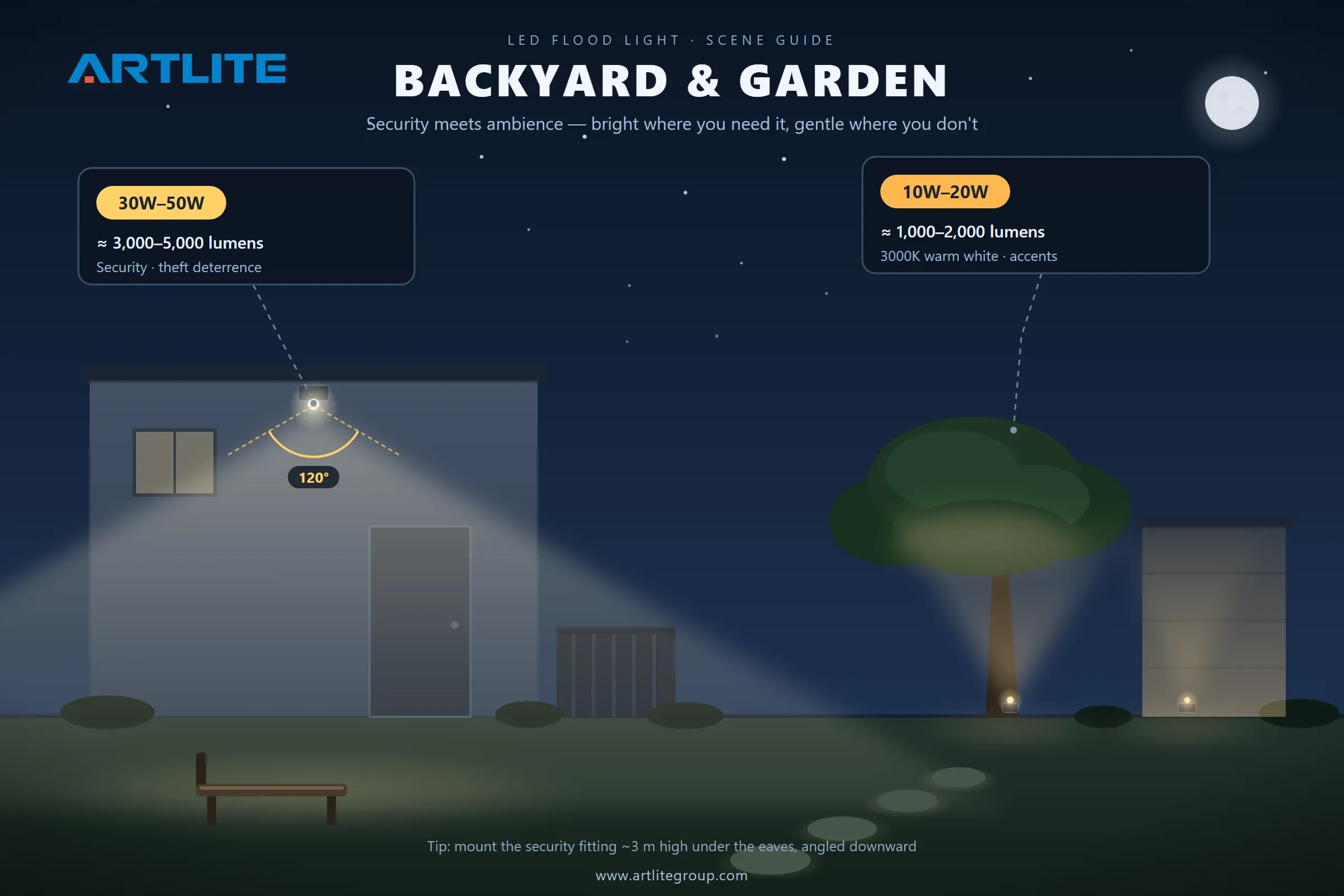
Garden flood lighting serves two different purposes: security and ambience. For everyday illumination and theft deterrence, mount a 30W to 50W flood light (3,000 to 5,000 lumens) under the eaves or on a wall at around 3 metres high, angled downward. One fitting at this height covers most of a typical residential backyard.
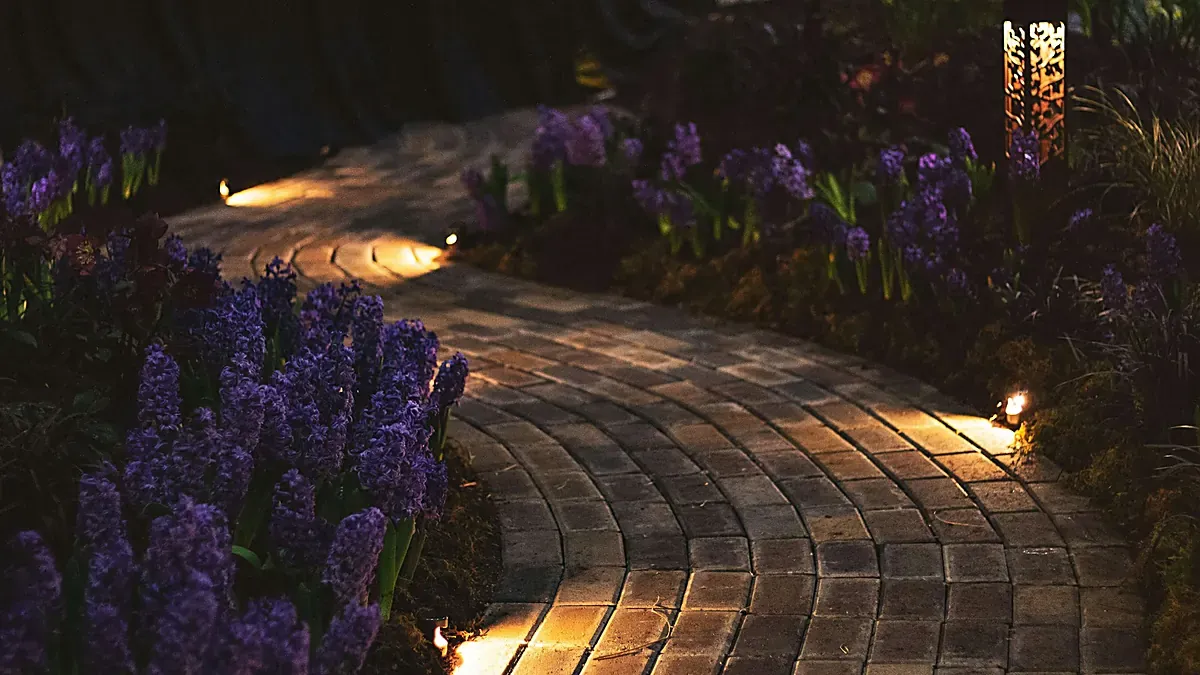
For landscape ambience - uplighting a feature tree, washing a textured wall or highlighting a garden path - a much lower output is needed. A 10W to 20W flood light producing 1,000 to 2,000 lumens is enough. Choose 3000K warm white rather than cool white: it brings out the natural greens and browns in planting and creates a warm, inviting atmosphere rather than a harsh institutional glow.
Expert Tip: Avoid Light Pollution
If your primary goal is security, resist the temptation to install a 100W flood light. Overly bright security lighting that switches on suddenly can be more disruptive than helpful - it blinds neighbours, disturbs wildlife and creates light pollution. A 30W unit with a motion sensor is far more effective: it only comes on when needed and provides enough light to identify a person at 10 metres.
Home Sports Court: Maximum Brightness for Fast-Paced Play
A half-court basketball area, badminton court or table tennis zone demands the highest light levels of any residential application. Fast ball sports require the eye to track small objects moving quickly through the air - insufficient brightness or uneven coverage leads to missed shots and, more importantly, sprained ankles.
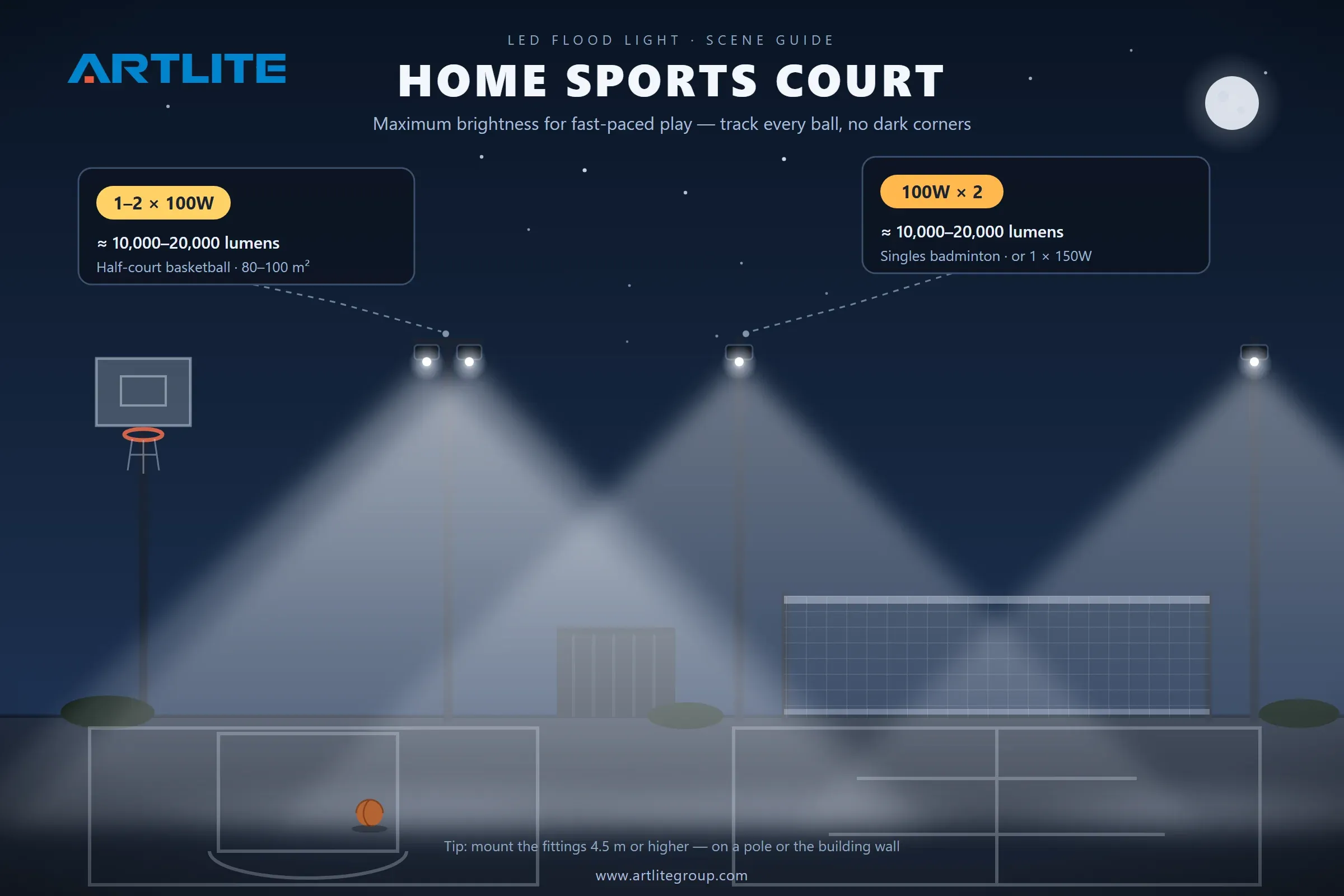
For a half-court basketball area (roughly 80 to 100 square metres), install one or two 100W LED flood lights producing a combined 10,000 to 20,000 lumens. For a standard singles badminton court, use at least two 100W fittings or one 150W unit. Mount the fittings 4.5 metres or higher on a pole or the building wall.
Expert Tip: Height and Angle Matter as Much as Wattage
Sports lighting must be mounted high enough (4.5 metres or above) and angled downward at 30 to 45 degrees. If the fitting is too low or aimed horizontally, players looking up to shoot or smash will be staring directly into the light source - a condition called disability glare that ruins visibility instantly. Always choose 5000K to 6000K cool white for sports: the higher colour temperature keeps players alert and provides the best colour rendering for a white ball against a dark background.
Quick Reference: LED Flood Light Selection Chart
Use this chart to match your space to the right LED flood light. Find your application in the first column, check the recommended mounting height and lumens, then read across for the equivalent LED wattage and colour temperature.
Applications | Suggested Installation Height | Lumen Range(lm) | Reference LED Wattage | Recommended Color Temperature |
Garden landscape or ambience | mount at 0.5 - 1.5 m (ground spike) | 800 - 1,500 lm | 10W - 15W | 3000K warm white |
Small garage or doorway | mount at 2.5 - 3 m | 1,500 - 2,500 lm | 20W - 30W | 4000K natural white or 6000K cool white |
Large yard or driveway security | mount at 3 - 4 m | 3,000 - 5,000 lm | 50W | 4000K natural white or 6000K cool white |
Half basketball court or backyard sports | mount at 4.5 - 6 m | 10,000 - 15,000 lm | 100W - 150W | 5000K - 6000K cool white |
Still Not Sure What You Need?
Tell us three things and we will recommend the right flood light: the approximate area in square metres, whether you have an existing pole or wall to mount it on, and whether you prefer a wired (AC 220V/110V) or solar-battery model.
Contact ARTLITE GROUP through the form below and our technical team will reply with a specific recommendation.